Facts Funnier Than Fiction
From One to One Million: The Terrifyingly Efficient Math of the Mosquito
The Hook: A Single Buzz in the Night
It is a sound etched into the human psyche: the high-pitched, electric whine of a single mosquito circling your ear just as you drift toward sleep. In that moment, she is merely a nuisance, a lone intruder stealing a few drops of blood. But from the perspective of a biological strategist, that single female is something far more formidable. She is the pilot of a reproductive engine capable of staggering exponential growth. This raises a haunting question for our modern world: if left entirely unchecked, how long would it take for that one buzz to become a million? By deconstructing the mosquito’s mathematical blueprint, we find ourselves staring at a thin, fragile line between a quiet evening and a population explosion.
The 40-Day Exponential Explosion
In the sterile vacuum of an “Absolute Theoretical Maximum”—the kind of perfect environment found only in a high-end laboratory—the speed of mosquito multiplication is nothing short of terrifying. In this scenario, we assume a world without friction: every egg survives, every offspring reproduces, and no predators, diseases, or environmental shifts exist to tap the brakes.
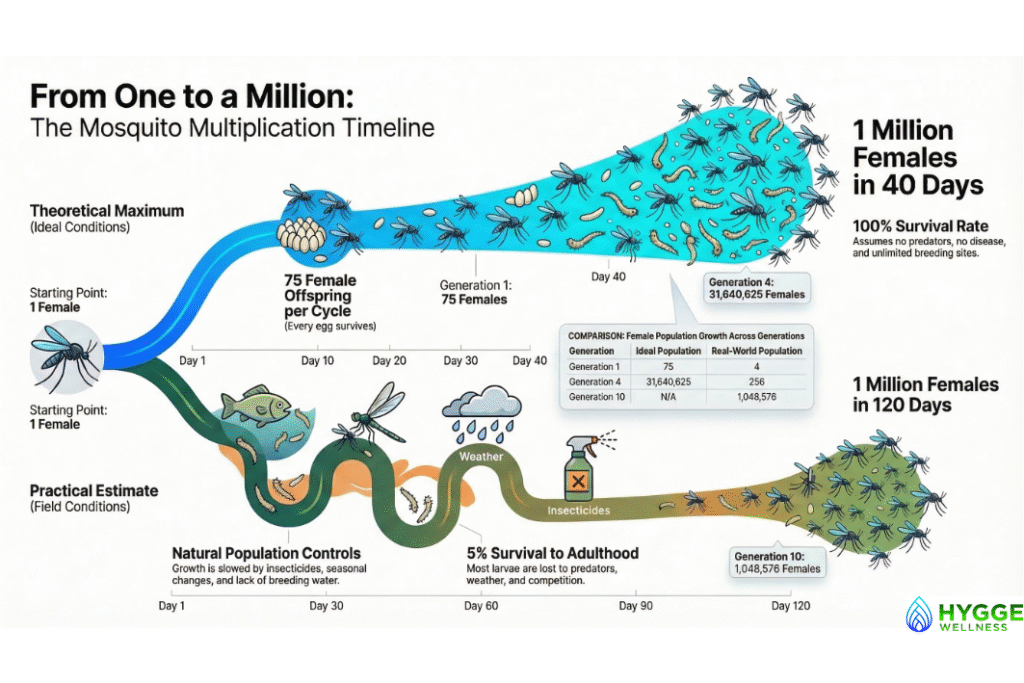
Under these ideal conditions, the mosquito’s lifecycle is a frantic sprint from puddle to pulse. With a generation time of just 10 days and an output of 75 female offspring per mother, the population reaches a massive tipping point in only four generations. While humans measure progress in years or decades, the mosquito rewrites the landscape in weeks. In less than a month and a half, a single ancestor produces a lineage of over 31 million descendants.
“One female mosquito could theoretically produce over 1 million female mosquitoes within about 40 days.”
The Brutal Reality of the 5% Survival Rate
In the wild, the “mosquito apocalypse” is held at bay by a relentless gauntlet of mortality. The shift from a 100% survival rate to a more realistic 5% survival rate fundamentally reconfigures the math. This survival bottleneck is the only reason we are not buried under a literal cloud of insects; nature kills 95% of them before they can take flight, yet they remain a global menace.
To reach the one-million mark in the field, the timeline stretches from 40 days to approximately 120 days (4 months). This delay is caused by a biological slowdown—the generation cycle expands from 10 days to 12 days—and a much tighter “Rule of 4.” In this practical model, 150 eggs yield only about four surviving females (150 \times 0.05 \times 0.5 \approx 3.75). It takes 10 full generations of these four survivors to hit the million-mosquito milestone.
Major population losses in the wild are fueled by:
- The rapid drying of breeding pools and puddles
- Predators such as fish, dragonflies, and other insects
- Larval competition for limited nutrients
- Disease and environmental stressors
- Sudden weather events and temperature drops
- Human-led insecticide applications
The Mathematical Engine—150 Eggs per Batch
The “engine” driving this resilience is the mosquito’s sheer reproductive volume. A typical female (such as those in the Aedes or Culex genera) lays between 100 and 200 eggs per batch. For our models, we use a median of 150. Because of a near-perfect 50/50 sex ratio, half of those will be females—the only relevant variable for population growth, as they are the ones who lay the next generation of “lottery tickets.”
The mosquito is a high-volume gambler, and the house almost always loses. Even with the brutal 5% survival rate, starting with 150 attempts per female ensures that the species wins by sheer weight of numbers. In warm climates, an egg can become an egg-laying adult in as little as 10 to 14 days. This efficiency ensures that even if a population is decimated, it can rebound and reach a million-fold increase within a single summer season.
Why We Aren’t Overrun (The Ecosystem’s Brakes)
If the math is this efficient, why isn’t the entire planet a mosquito swarm? Real-world ecosystems possess “brakes” that do more than just slow growth—they often cap it or cause total population crashes. Beyond the gauntlet that larvae face, adult populations are strictly limited by:
- Breeding Site Scarcity: Mosquitoes require standing water; without it, the engine stalls.
- Seasonal Hard Stops: Winter and extreme dry seasons act as a reset button for local populations.
- Human Intervention: Our role is the primary strategic barrier to the 40-day explosion.
Human behavior—cleaning gutters, discarding old tires, and organized spraying—is the critical external check. We are the architects of the environment, and our intervention is often the only thing standing between a manageable population and a mathematical runaway.
Conclusion: A Fragile Balance
The mosquito is a master of biological arithmetic, existing in the tense gap between a 40-day theoretical explosion and the 120-day practical struggle. This balance is fragile. We must ask ourselves: what happens when we inadvertently tip the scales? As human-built environments provide endless artificial breeding sites and climate change erodes our seasonal “brakes,” we risk creating the very “ideal conditions” that allow the mosquito’s terrifyingly efficient math to reach its full, unchecked potential.
Eliminating one mosquito today is eliminating one million in the near future. Trap them not for today alone for tomorrow also. You are doing a community service.