Mosquito Biology and Anatomy
Mosquito Biology and Anatomy
Introduction
Mosquitoes are small flying insects belonging to the family Culicidae. Despite their small size, they possess a highly specialized body structure that allows them to fly efficiently, detect hosts, and feed on blood when necessary.
Understanding mosquito biology and anatomy helps explain how mosquitoes locate humans and animals, how they feed, and how they transmit diseases. The body of a mosquito is adapted for flight, sensing environmental cues, and obtaining nutrients needed for survival and reproduction.
The mosquito body can be divided into three main sections: head, thorax, and abdomen.
External Body Structure
Like most insects, the mosquito body consists of three primary parts.
Head
The head contains the mosquito’s sensory organs and feeding apparatus.
Major components of the head include:
Compound eyes, which help detect movement and light.
Antennae, which detect chemical signals such as carbon dioxide and body odors.
Palps, which assist in sensing the environment.
Proboscis, the long needle-like mouthpart used for feeding.
These structures allow mosquitoes to locate hosts and navigate their environment.
Thorax
The thorax is the central part of the mosquito’s body and functions mainly in movement.
The thorax contains:
The muscles that power flight
Three pairs of legs
One pair of wings
This section is highly muscular because it controls the wing movements necessary for flight.
Abdomen
The abdomen is the elongated rear portion of the mosquito’s body.
It performs several important functions:
Digestion of food
Storage of nutrients
Development of eggs in female mosquitoes
The abdomen expands significantly when a female mosquito takes a blood meal.
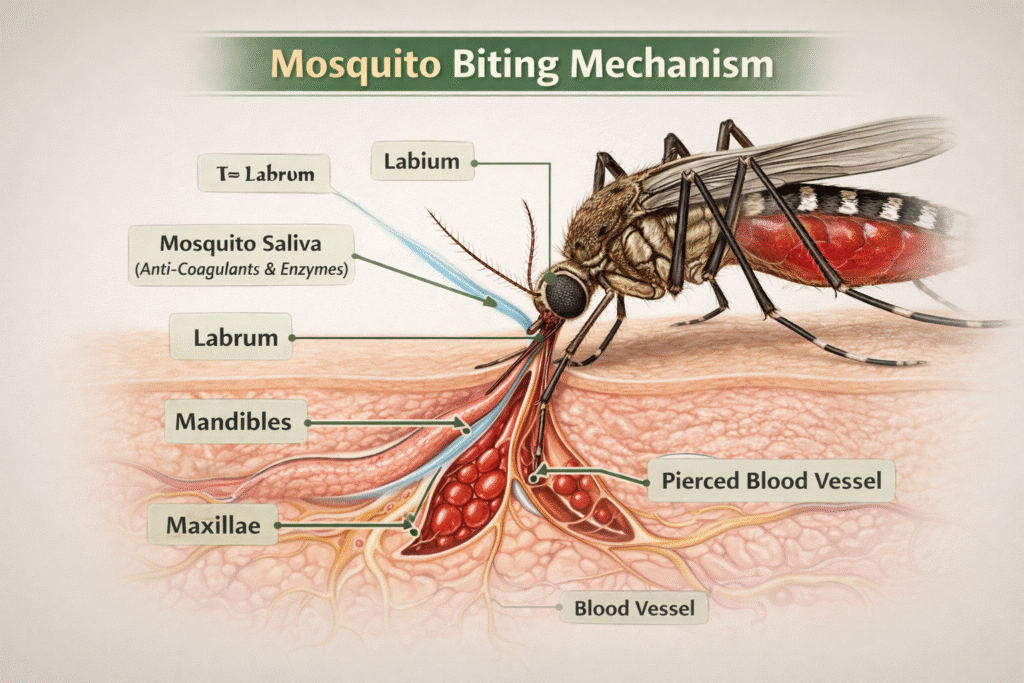
The Proboscis – How Mosquitoes Bite
The proboscis is the long, flexible feeding tube extending from the mosquito’s head. Although it appears like a single needle, it is actually composed of several specialized mouthparts.
These mouthparts work together to pierce the skin and draw blood.
Key components include:
Labrum – helps suck blood
Mandibles and maxillae – pierce the skin
Labium – acts as a sheath surrounding the other mouthparts
Only female mosquitoes use the proboscis to obtain blood. Male mosquitoes feed mainly on plant nectar.
Blood meals provide proteins that female mosquitoes need for egg production.
Sensory Organs
Mosquitoes possess highly sensitive sensory organs that allow them to detect potential hosts from a distance.
Carbon Dioxide Detection
Humans and animals release carbon dioxide (CO₂) while breathing. Mosquitoes are able to detect small changes in CO₂ concentration in the air.
This signal helps mosquitoes locate living hosts.
Heat Detection
Mosquitoes can also sense body heat. Warm surfaces help guide them toward exposed skin areas.
Combined with other cues such as odor and moisture, heat detection allows mosquitoes to find suitable feeding locations.
Wing Structure and Flight Mechanism
Mosquitoes have one pair of narrow wings attached to the thorax. The wings are covered with tiny scales that influence their aerodynamic properties.
The wing muscles in the thorax allow mosquitoes to beat their wings very rapidly, typically several hundred times per second.
This rapid wing movement produces the characteristic buzzing sound often heard when mosquitoes are flying nearby.
Mosquito flight is efficient and allows them to:
Hover
Change direction quickly
Travel short distances while searching for hosts
Blood Feeding Mechanism
Female mosquitoes require blood to obtain proteins necessary for egg development.
The feeding process involves several steps:
The mosquito locates a host using sensory cues such as CO₂ and body odor.
The proboscis pierces the skin.
Saliva is injected into the skin to assist feeding.
Blood is drawn through the proboscis into the mosquito’s digestive system.
This feeding process usually lasts only a few minutes.
Mosquito Saliva
During feeding, mosquitoes inject saliva into the skin. This saliva contains several substances that assist blood feeding.
These substances may include:
Anticoagulants, which prevent blood from clotting.
Enzymes, which help maintain blood flow.
Compounds that reduce pain sensation during the bite.
The body’s immune response to mosquito saliva is what often causes itching and swelling at the bite site.
Some disease-causing organisms, such as viruses or parasites, can be transmitted during this feeding process if the mosquito is infected.
Importance of Understanding Mosquito Biology
Studying mosquito anatomy and behavior helps scientists develop effective strategies to control mosquito populations and reduce the spread of mosquito-borne diseases.
Knowledge of mosquito biology supports:
Vector control programs
Disease prevention strategies
Development of mosquito traps and repellents
Public health research
Understanding how mosquitoes function is an important step in protecting communities from mosquito-borne diseases.
Here is the correct explanation you can add near the illustration on your page.
Which Part of the Mosquito Penetrates the Blood Vessel?
When a mosquito bites, the structure that enters the skin is not a single needle but a bundle of six very fine needle-like mouthparts called stylets. These stylets form the inner part of the mosquito’s feeding apparatus.
The main parts that penetrate the skin include:
1. Labrum
The labrum forms the central food canal through which blood is drawn into the mosquito. It acts like a tiny straw once the skin is pierced.
2. Mandibles
The mandibles are sharp cutting structures that help slice through the skin.
3. Maxillae
The maxillae have tiny saw-like edges that help the mosquito push deeper into the skin tissue while searching for a blood vessel.
4. Hypopharynx
The hypopharynx acts as a tube through which mosquito saliva is injected into the skin. This saliva contains substances that prevent blood from clotting and allow blood to flow smoothly.
The Part That Does NOT Enter the Skin
Labium
The labium is the outer sheath that surrounds the stylets. When the mosquito bites, the labium bends backward and stays outside the skin while the thin stylets penetrate inside.
Simplified Sequence of a Mosquito Bite
The mosquito lands on the skin.
The labium bends back.
The thin stylets penetrate the skin.
The mosquito searches for a blood vessel.
Saliva is injected through the hypopharynx.
Blood is sucked through the labrum.
Why the Bite Itches
The itching and swelling that occur after a mosquito bite are caused by the body’s immune reaction to proteins in mosquito saliva, not by the piercing itself.
If you want, I can also make a very clear labeled diagram showing the six stylets (labrum, mandibles, maxillae, hypopharynx, labium) in a simple educational style that would be perfect for your website page.
Functions of the Mosquito Mouthparts Shown in the Illustration
When a mosquito bites, several extremely thin mouthparts work together to pierce the skin, locate a blood vessel, inject saliva, and draw blood. These structures are collectively called stylets.
The following parts are involved in the feeding process.
Labrum
Function: Blood-sucking tube
The labrum forms the main channel through which blood is sucked into the mosquito. It acts like a very thin straw.
Once the skin is pierced and a blood vessel is located, the labrum draws blood from the host into the mosquito’s digestive system.
Mandibles
Function: Skin-cutting blades
The mandibles are sharp, needle-like structures that help the mosquito cut through the skin.
They act like tiny blades that separate skin tissues so that the other mouthparts can move deeper into the skin.
Maxillae
Function: Penetration and anchoring
The maxillae have tiny saw-like teeth along their edges. These teeth help the mosquito push deeper through the skin while probing for a blood vessel.
They assist the mosquito in stabilizing its feeding apparatus while it searches for blood.
Hypopharynx
Function: Saliva injection tube
The hypopharynx is a narrow tube that delivers mosquito saliva into the skin.
Mosquito saliva contains several substances that help the feeding process, including:
Anticoagulants that prevent blood from clotting
Enzymes that keep blood flowing
Compounds that reduce pain detection during the bite
Unfortunately, if the mosquito carries a pathogen such as a virus or parasite, it may also be transmitted through the saliva.
Blood Vessel
The mosquito’s mouthparts do not always directly pierce a blood vessel immediately. Instead, the mosquito probes through the skin until it finds a small blood vessel.
Once located, the labrum begins sucking blood, and the mosquito’s abdomen gradually fills with the blood meal.
Labium (Important Note)
Although not shown penetrating the skin, the labium is the outer sheath surrounding the mouthparts.
During the bite:
The labium bends backward
The inner stylets enter the skin
The labium remains outside the skin
Why Mosquito Bites Cause Itching
The itching and swelling after a mosquito bite are caused by the body’s immune reaction to proteins in mosquito saliva, not by the piercing of the skin itself.
If you want, I can also help you create a short caption block for the image such as:
“Mosquito feeding mechanism showing the stylets that penetrate the skin and the blood vessel from which the mosquito draws blood.”
This helps visitors quickly understand the diagram.
Below is a clear educational explanation you can use for a page or section titled something like “How Mosquitoes Transmit Diseases”. It explains the complete transmission cycle in simple steps.
How Mosquitoes Transmit Diseases
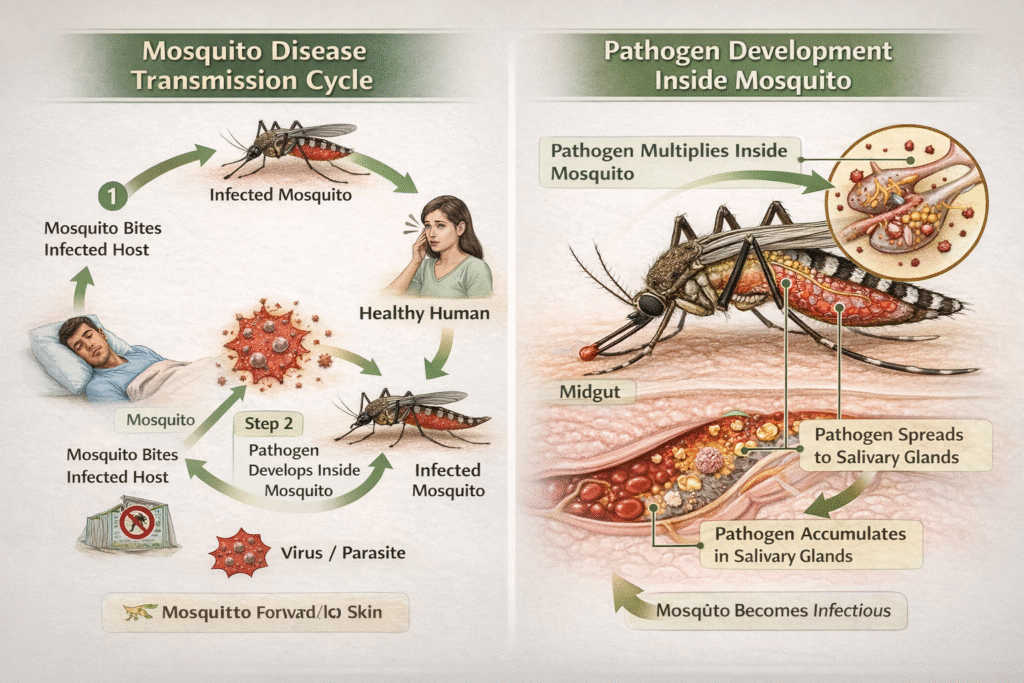
Mosquitoes can transmit several diseases to humans, including malaria, dengue, chikungunya, and Japanese encephalitis. However, mosquitoes are not born carrying these diseases. They become infected only after feeding on an infected host.
The transmission of disease usually involves three stages:
The mosquito becomes infected.
The disease-causing organism develops inside the mosquito.
The infected mosquito transmits the pathogen to another person.
This process is known as vector-borne transmission.
Stage 1: How a Mosquito Becomes Infected
A mosquito becomes infected when it bites a person or animal that already carries a disease-causing organism in the bloodstream.
During a blood meal:
The mosquito inserts its mouthparts into the skin.
Blood is drawn through the labrum into the mosquito’s digestive system.
If the blood contains viruses, parasites, or other pathogens, these organisms enter the mosquito along with the blood.
At this stage, the mosquito has ingested the pathogen, but it cannot yet transmit the disease to another person.
Stage 2: What Happens Inside the Mosquito
Once inside the mosquito, the pathogen must survive and develop before it can be transmitted.
The process differs depending on the disease.
For Viral Diseases (Dengue, Zika, Chikungunya)
The virus enters the mosquito’s midgut along with the blood meal.
The virus multiplies inside the mosquito’s body.
It spreads from the gut into other tissues.
Eventually, the virus reaches the salivary glands.
This process may take several days, depending on temperature and mosquito species.
For Parasitic Diseases (Malaria)
In malaria transmission:
The mosquito ingests Plasmodium parasites from infected blood.
The parasites undergo several stages of development inside the mosquito.
They migrate through the mosquito’s body.
Finally, they accumulate in the salivary glands.
Only after this development stage can the mosquito transmit malaria.
Extrinsic Incubation Period
The time required for the pathogen to develop inside the mosquito is called the extrinsic incubation period.
During this period:
The mosquito is infected but cannot yet transmit the disease.
Once the pathogen reaches the salivary glands, the mosquito becomes infectious.
Environmental factors such as temperature and humidity can influence how quickly this process occurs.
Stage 3: Transmission to Humans
When the infected mosquito bites another person, disease transmission can occur.
During the bite:
The mosquito inserts its mouthparts into the skin.
The mosquito injects saliva into the skin to prevent blood clotting.
If the mosquito is infected, the pathogen present in the saliva enters the human bloodstream.
This is how diseases such as dengue, malaria, and chikungunya are transmitted from mosquitoes to humans.
Why Mosquitoes Are Effective Disease Vectors
Mosquitoes are particularly efficient at spreading diseases because:
They feed on blood from multiple hosts.
They live close to human settlements.
Their saliva provides a direct pathway for pathogens to enter the bloodstream.
Some mosquito species feed frequently during their lifespan.
These characteristics make mosquitoes one of the most important vectors of infectious diseases worldwide.
Important Note
Not every mosquito carries disease. Only mosquitoes that have previously bitten an infected host and completed the internal development stage of the pathogen can transmit the disease.
Controlling mosquito populations and preventing mosquito bites remain key strategies for reducing the spread of mosquito-borne diseases.
If you want, I can also help you add two extremely useful educational diagrams for this page:
Mosquito Disease Transmission Cycle Diagram
Pathogen Development Inside Mosquito (midgut → salivary glands)
These diagrams make the explanation much clearer for readers.